

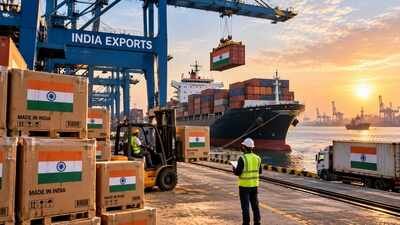
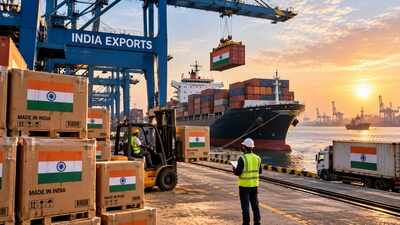
By Anuj GuptaThe WTO‘s 2026 World Trade Report comes at an awkward time for India. The world is becoming more fragmented, governments are rediscovering industrial policy, supply chains are being rearranged and confidence in ever-deeper trade liberalisation has weakened. Yet its central message is difficult to ignore: a more fragmented trading system is poorer, while trade remains a powerful mechanism for acquiring technology, markets and productivity.For India, this cannot be reduced to choosing between protectionism and free trade. We should neither retreat behind tariffs in the name of self-reliance nor assume every reduction in a trade barrier is automatically good industrial policy. The answer is straightforward: use openness to build capabilities, and protection only when it helps build them.This is where Ha-Joon Chang, the South Korean economist known for his work on industrial policy and development, is useful. In Kicking Away the Ladder, Chang challenged the idea that today’s rich countries became successful simply by embracing free trade. Britain, the United States, Germany, Japan and later the East Asian economies all used industrial policy while climbing the technological ladder. Tariffs, subsidies and government procurement gave domestic industries time and incentives to learn.Chang’s argument is sometimes reduced to “protectionism works”. The more important point is that development requires changing what a country is capable of doing. Comparative advantage is not only discovered; it can also be created.That distinction matters for India. Take electronics. India’s success in becoming a major mobile-phone assembly base is significant, but assembly cannot be the destination. If the next decade produces more final assembly while higher-value components, machinery, design and intellectual property remain elsewhere, India will have expanded manufacturing without transforming its capabilities. The objective should be to build the ecosystem around assembly: components, tooling, design, testing, engineering and R&D.This changes how we should think about tariffs. Temporary protection can give a new industry time to invest, learn, achieve scale and become internationally competitive. But protection must produce learning and competitiveness. If an industry remains dependent on protection while productivity stays poor, the policy has failed.India’s industrial policy therefore needs greater discipline. Production-linked incentives, tariffs, procurement and other support should be judged by measurable outcomes: productivity, exports, technology acquisition, R&D and supplier development. If those outcomes do not materialise, support should be reconsidered. Otherwise industrial policy protects incumbents rather than building capabilities.India should also not treat every import as evidence of industrial weakness. Machinery, components, intermediate goods and technology can make domestic industry stronger; making them unnecessarily expensive can make Indian manufacturers less competitive. The question should not simply be how much of a product is made in India, but how much capability India has acquired by making it.The same thinking should guide India’s free-trade agreements. India should pursue FTAs that provide meaningful access to large markets and integrate Indian companies into global supply chains. But we should ask whether firms are ready to compete, whether sectors need transition periods and whether premature opening could destroy capabilities India might otherwise develop. There is no virtue in protecting an industry forever, but little in exposing an infant industry too early.The WTO report is especially relevant because, as tariffs have fallen, many important barriers to trade have moved behind the border: standards, certification, customs procedures and regulation. This is where India’s next generation of reform should focus. India needs to move from a permission-based trading system towards a rules-based one, with faster risk-based customs, predictable standards and digital, time-bound procedures. Businesses should know the rules before they invest, rather than discover them through administrative discretion afterwards.This matters even more as services and digital trade expand. India’s opportunity increasingly lies in combining human capital with technology. Artificial intelligence could expand digitally delivered exports in software, engineering, finance, healthcare and design, but capturing this opportunity will require regulatory compatibility with other countries.The choice before India is therefore not between Atmanirbharta and globalisation, but between passive and strategic integration. The first accepts today’s comparative advantages; the second uses global markets, foreign investment, technology and competition to build capabilities that allow India to capture higher-value activities over time.This is where the WTO and Chang are less contradictory than they initially appear. The WTO explains why India cannot withdraw from global trade; Chang explains why integration alone does not guarantee technological upgrading.India therefore needs a more demanding trade strategy: open where openness gives Indian firms access to technology, capital, inputs and markets; protect selectively where there is a credible case for developing a new capability; and impose enough discipline to ensure that protection eventually produces competitiveness rather than dependence.The objective should not be to protect Indian industry from the world. It should be to use the world to make Indian industry stronger. That is what it would mean for India to truly trade its way up.(Anuj Gupta is the MD of BowerGroupAsia)