

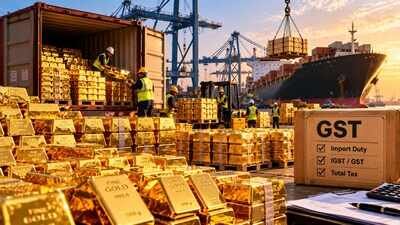
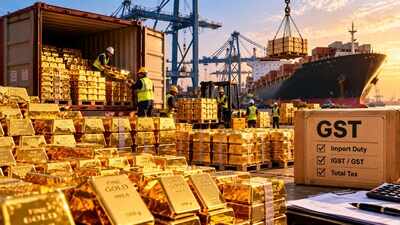
Government entities such as MMTC and the State Trading Corporation of India could soon be brought within the goods and services tax (GST) framework for imports of gold and other precious metals.The proposal is aimed at ensuring that different channels used to import bullion face similar tax treatment and at reducing classification and valuation disputes that have resulted in lengthy litigation.The issue is likely to be discussed at the GST Council meeting on October 8. The broader proposal seeks to harmonise the tax treatment of bullion brought into the country through banks, nominated agencies and exchanges.Currently, banks and certain nominated agencies are required to pay 3% GST when importing precious metals.Also Read | Gold at Rs 1.5 lakh per 10 grams is pushing middle-class Indian buyers to silver who are getting 650 grams of silver at the same price; some betting silver at Rs 2.3 lakh per kg may hit Rs 4 lakh
What the proposal means
If implemented, the proposal could end the preferential treatment available to some agencies since 2017. At that time, imports of gold, silver and platinum were largely routed through a limited number of banks and nominated agencies.Since then, bullion exchanges have emerged as another import channel, with duties and taxes being paid through this route.Renisha Chainani, chief research officer at Augmont, told ET that eliminating the exemption would create a more level playing field among the different import routes.“The 2017 exemption made sense when only a few banks and nominated agencies brought bullion into India. Now that bullion exchanges offer another route, everyone should follow the same rules on duty and tax,” she said.Chainani said the immediate impact could be a moderation in bullion imports by banks and nominated agencies, as the need to pay tax upfront could increase their working-capital requirements and put pressure on margins. This could, in turn, temporarily push up local premiums and slow the flow of bullion to jewellers.“Over time, though, more trade should shift to the exchanges, and gold pricing should become more transparent and better organised,” she said.Industry executives said the proposal is also intended to tackle practical difficulties that can arise when classification codes are altered in the budget but the corresponding tariff notifications are not updated accordingly. Such mismatches have led to disputes over whether a particular change affects the goods themselves or only their classification.Putting all the import channels under the same tax treatment could therefore help reduce differences in interpretation. It could also make the process of sourcing bullion more transparent and efficient for jewellers.Also Read | Unscrupulous jewellers may use fake stamps to mark your gold: As hallmarking charges rise to Rs 75 from Rs 45 Gem and Jewellery Domestic Council flags risk of rise in fraudsters
Festive season coming: Will silver outshine gold?
This festive season, silver could emerge as a stronger alternative to gold for Indian buyers as gold prices remain expensive despite their recent decline. Traditionally, silver has played a secondary role to gold in India’s jewellery market. This year, however, the white metal appears set to attract significantly more attention.With gold still unaffordable for many middle-class consumers, silver is increasingly being considered as an alternative. The elevated price of gold has put the yellow metal beyond the reach of many buyers.Jewellers and traders are broadening their silver offerings to attract both consumers and investors. Their products now range from jewellery and idols to furniture. Once largely overshadowed by gold, silver is emerging as a potential favourite during the festive season, which begins with Navratri on October 11.At prevailing prices, 10 grams of 24-karat gold costs around Rs 1.5 lakh. The same amount could buy roughly 650 grams of silver.At the same time, the cost of gold hallmarking has increased. Hallmarking allows consumers to verify the purity of the gold they purchase. The higher charges have also raised concerns that counterfeit hallmarking stamps could become more prevalent, allowing fraudsters to pass off fake marks as genuine.The industry fears that the increased fee could encourage unscrupulous jewellers to use forged hallmarking marks to avoid the additional cost.The concern is considered particularly relevant in tier-2, tier-3 and tier-4 cities, where consumer awareness remains relatively limited.