

On August 5, 2025, US President Donald Trump announced 25% penal tariffs on India for its purchase of crude oil from Russia. One year later, India faces the prospect of up to 100% tariffs for its Russian crude oil purchases! A lot has changed in the last year, yet when it comes to tariffs related to Russian crude – the Trump administration seems to have come full circle.India faced with 50% tariffs (25% reciprocal and 25% penal) did not stop procuring Russian crude. In October 2025, the US announced sanctions on some Russian oil firms. This led to a decline in oil purchases from Russia as lower quantities of non-sanctioned crude were available. In February this year, India and the US announced an interim trade deal framework agreement, which reduced tariffs on India to 25% and also removed the 25% penal tariffs for Russian crude purchases. Trump claimed India would stop buying crude from Moscow, but that never happened as the Middle East Conflict began.A year since the whole penal tariff cycle began – India now faces uncertainty related to its Russian crude purchases. A new Russia related sanctions bill in the US may see the light of the day if passed this year implying that Trump would have the power to impose tariffs on India again.What’s the bill about, what powers does it give the US President? Will India face new tariffs and importantly, will it stop buying Russian crude oil?
What the Russia Sanctions Bill proposes
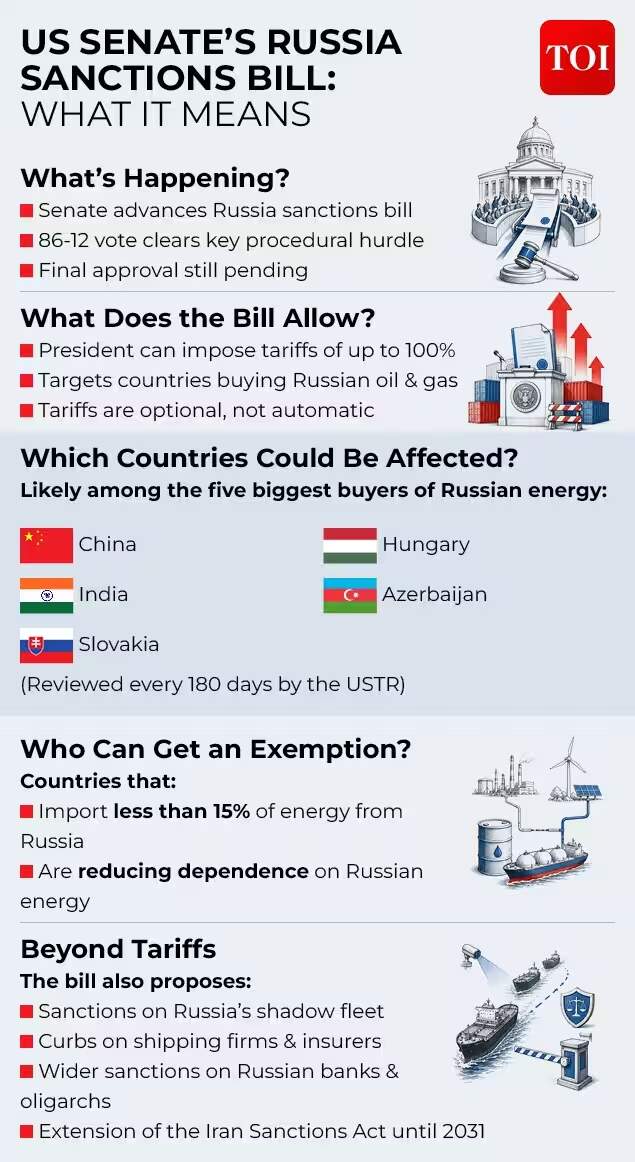
The proposed Lindsey O. Graham Sanctioning Russia and Iran Act of 2026, if passed, will give the US President the authority to impose tariffs of up to 100% on countries that buy crude oil and gas from Russia in big quantities. The decision on whether such a tariff should be imposed rests with the American President.
US Senate’s Russia Sanctions Bill: What it means
Before deciding on tariffs, the US Trade Representative (USTR) will review the countries which are the five largest importers of Russian energy. This review will happen every 180 days and then the US President will decide on whether a tariff should be imposed. The Bill allows for both penal tariffs and exemptions, depending on what the US President decides.Those countries that import less than 15% of their total energy needs from Russia and also show efforts to reduce the dependence will be eligible for an exemption from the tariffs. The bill also proposes secondary sanctions on shipping companies, insurers and vessels that are linked to Russia’s ‘shadow fleet’. At present the list of top five importers of Russian energy is likely to include China, India, Slovakia, Hungary and Azerbaijan.
Importance of Russian crude For India
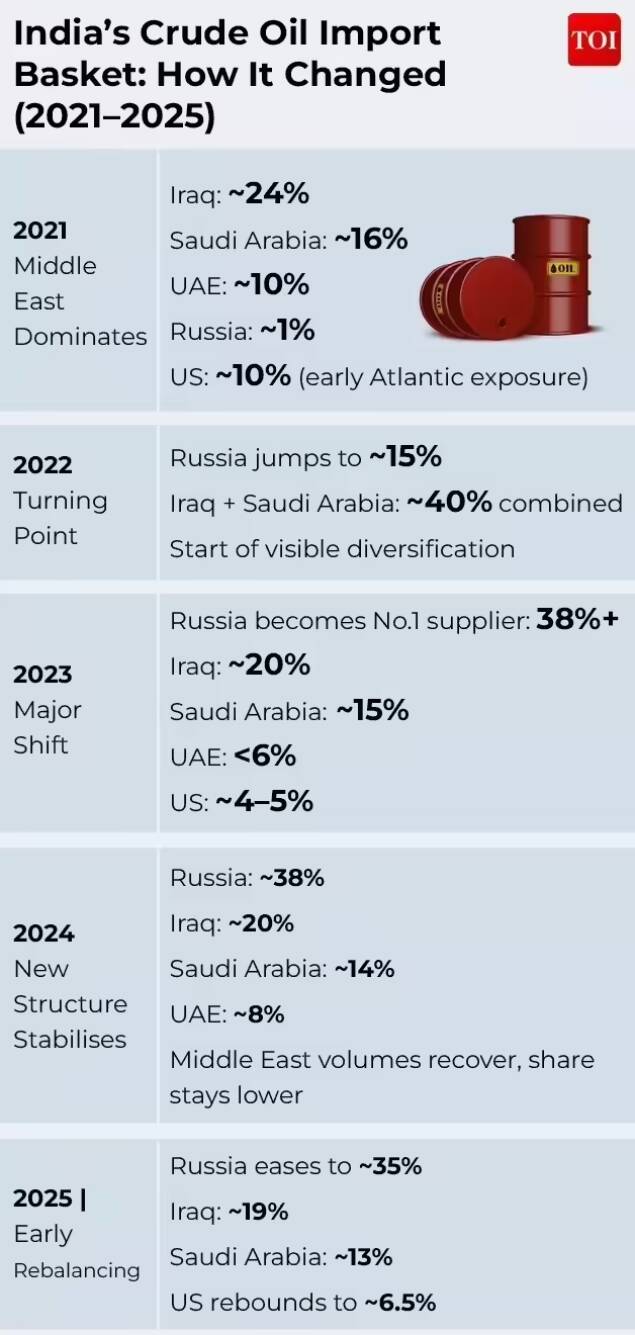
The Bill comes at a time when India’s dependence on Russian crude oil imports has gone up and is touching record highs. Russia was never a major oil supplier for India but after Moscow’s war with Ukraine began and Europe stopped buying Russian crude, it became available at huge discounts for India.Since 2022, Russia’s oil exports to India have steadily gone up and the share in India’s overall crude oil imports has been above 30% for over three years now. It was only in early 2026 when India’s oil imports from Russia went down after the US imposed sanctions on Russian majors Lukoil and Rosneft. Before a clear trend could emerge, the US-Iran war started, rendering Middle East oil inaccessible. As India stepped up oil purchases from Russia, the US also waived sanctions on Russian crude. The waiver has since then lapsed but India continues to buy Russian crude in large quantities with numbers touching record highs in recent months.Experts note that Russian crude has become the cornerstone of India’s crude oil procurement. So this raises the important question: Can and will India stop buying Russian crude if Trump announced penal tariffs?
Realistic chance of Russian crude disappearing from India’s imports?
No. Russia supplied approximately 55% of India’s crude imports in July, the highest share seen since India began large-scale purchases following the Ukraine conflict. Russian crude remains important from both energy security and refining economics perspectives.Hence, experts see a complete halt to Russian crude imports as an unlikely scenario in the near term.Kpler’s Sumit Ritolia doesn’t see dependence on Russian crude coming down any time soon, especially given the disruptions in the Middle East.“Russian crude has been India’s best hedge against supply disruptions over the past few years and now accounts for roughly 50% of its crude imports. Beyond attractive economics, it has provided reliable supply security despite fluctuations in discounts,” Ritolia tells TOI.“Indian refiners are unlikely to abandon Russian barrels overnight unless sanctions materially disrupt shipping, insurance or payment mechanisms. Any reduction would likely be gradual rather than abrupt,” he says.Prashant Vashisht, Senior Vice President at ICRA is of the view that India will not stop buying Russian crude oil unless and until it is sanctioned.“Last year when the 25% penal tariffs were imposed, India continued to buy from Russia and the supplies reduced only when Russian oil majors were sanctioned, making the crude economically unviable. Traditionally, India has not bought sanctioned oil, whether from Iran, Venezuela or Russia. But tariffs by themselves are unlikely to be a deterrent,” he tells TOI.According to Praveen Rai, Director , Grant Thornton Bharat, “Any potential reduction is more likely to be gradual rather than abrupt, as Indian refiners would need to balance commercial considerations, supply security, crude quality suitability, and long-term contractual arrangements.”“The ultimate impact would depend on the severity of the tariff measures and whether alternative crude supplies can be secured at competitive prices,” he tells TOI.The economic impact of letting go of Russian oil also cannot be ignored.“A scale-down of Russian inflows even by a third would require India to replace roughly 0.8-1.0 million barrels per day of crude, which is up to 20% of India’s total current crude import volume based on July data,” says Praveen Rai.“Considering the discount on Russian Urals already came down to just $1-2 per barrel and the additional impact of longer routes, freight, and insurance cost might add another $2-3 per barrel, the combined annual impact due to the replaced Russian crude volumes could be anywhere between $1-1.8 billion,” he says.“The bigger impact will likely come from the broader market reaction. If the bill causes India, China and other major buyers to reassess Russian crude flows, it could tighten the market by forcing a re-routing of Russian barrels. For India, every additional $1/bbl increase in crude price would translate into approximately $2 billion in the import bill,” he adds.
What beyond Russia for India?
India has a diversified crude basket with over 40 countries available as suppliers. Recently India has raised its purchases from Venezuela as well.Experts believe procurement from OIraq, Saudi Arabia, the UAE, the US, West Africa, Brazil and Guyana could be stepped up if Russian crude becomes unviable.“However, replacing Russian volumes entirely would be extremely challenging under current market conditions. Supply security remains the primary concern, and with Middle Eastern exports constrained by geopolitical risks, the availability of alternative barrels at the scale of Russian supply is limited,” points out the Kpler expert.“Any replacement would likely involve longer-haul Atlantic Basin crudes, resulting in higher freight costs and increased competition for available cargoes,” he cautions.The replacement math is not straightforward either.“Given India’s heavy reliance on imported crude, this would materially increase its import bill, compress refinery margins and intensify competition for alternative supplies,” warns Sumit Ritolia.
How India’s Crude Oil Import Basket Has Changed Over Years
If Russian crude becomes difficult to procure, India would have to replace over 2.5-2.8 million bpd, which is a much larger challenge than it would have been before the breakout of the Russia-Ukraine war when Russian crude accounted for only a small share of imports.“India has one of the most diversified crude sourcing portfolios among major importers. In the event of reduced Russian imports, refiners could increase purchases from traditional Middle Eastern suppliers such as Iraq, Saudi Arabia, and the UAE, while also expanding procurement from the United States, West Africa, Latin America, and potentially Venezuela. UAE and Saudi Arabia already account for about 450,000-500,000 bpd imports each,” notes Praveen Rai.“The challenge is that the ongoing Middle East tensions have already tightened global supply chains and increased freight and insurance costs. Hence, replacement barrels are available, but they are likely to be more expensive and may involve longer shipping routes compared to current Russian supplies,” he adds.
Options for Trump administration
Experts see the Bill as a pressure tactic, but one that has notably found bipartisan support. It has crossed an important procedural hurdle, indicating that its prospects have strengthened.Yet it still faces hurdles as lawmakers on both sides have already raised objections to it. The biggest point of contention has been the sweeping power it grants the President to impose tariffs at will. Donald Trump administration’s earlier reciprocal tariffs have already been struck down by the US Supreme Court.The challenge lies in the House of Representatives, where some Democrats and Republicans reportedly fear that it could raise inflation and create a precedent for future administrations to impose broad secondary tariffs on countries rather than just entities. The House is in recess till the end of August. With congressional elections approaching, some lawmakers believe that the bill may not secure an approval this year.Another interesting point to note is that if the Trump administration chooses to squeeze global oil supplies by sanctioning Russia or imposing tariffs on countries that buy crude from Moscow, the ripple effects would be felt globally.China and India are among the top buyers of Russian crude, yet last year, Trump decided to impose tariffs only on India. This time around the move to get the bill passed, and possibly impose tariffs comes when Middle East supplies are still somewhat disrupted and fresh conflict in the Red Sea is threatening alternative routes as well.“The US will likely weigh its geopolitical objectives against the risk of pushing global oil prices higher. While additional pressure on buyers of Russian crude is possible, whether India faces direct tariffs will depend not only on the sanctions bill itself but also on broader US-India trade negotiations, the global oil market and the evolving situation in the Middle East,” says Sumit Ritolia.Back in March when the Strait of Hormuz was de facto closed, the Trump administration waived sanctions on Russian crude in a bid to stabilize global oil prices. So clearly, oil prices above a certain level do not sit comfortably in America’s economic interests either with added inflationary pressures rendering policy making difficult.In this backdrop it is anybody’s guess whether Trump will impose tariffs if the bill is passed – but the tool would exist. Yet another factor to watch would be if India will again be singled out for tariffs or will China also be on the list this time? Finally, tariffs have not stopped India from buying Russian crude in the past, will it be any different this time?