
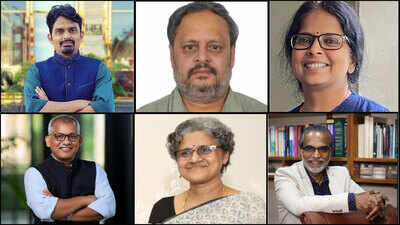
For students aspiring to become scientists, engineers or researchers, prestigious fellowships are more than just awards—they recognise years of innovation, perseverance and discoveries that create real-world impact. This year, six faculty members from the Indian Institute of Technology (IIT) Madras have been selected for the Anusandhan National Research Foundation (ANRF) J. C. Bose Grant, one of India’s most prestigious honours for senior scientists and engineers.Their research spans affordable prosthetics, clean drinking water, next-generation optical communications, carbon capture, biomedical engineering and advanced chemistry, highlighting how cutting-edge science can improve millions of lives.Congratulating the awardees, IIT Madras Director Prof. V. Kamakoti said the recognition reflects the institute’s commitment to high-quality research. “I congratulate all my distinguished colleagues. This demonstrates the high quality of research and development in critical and emerging technologies happening at IIT Madras.”
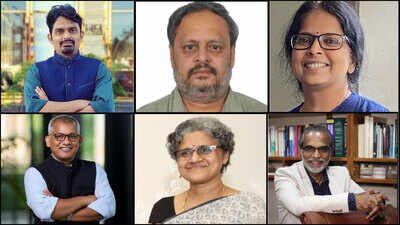
Meet the six IIT Madras professors honoured this year
Prof. Sujatha Srinivasan : Transforming lives through affordable prosthetics
Professor Sujatha Srinivasan from the Department of Mechanical Engineering has dedicated her career to improving mobility and independence for people with disabilities.As Head of the TTK Centre for Rehabilitation Research and Device Development (R2D2) and the National Center for Assistive Health Technologies (NCAHT) at IIT Madras, she has led the development of several affordable assistive technologies tailored to Indian lifestyles.Among her team’s innovations are the NeoFly-NeoBolt system, the Standing Wheelchair, the Kadam prosthetic knee and the lightweight YD One wheelchair. She also holds several Indian, US and international patents in prosthetics and assistive technologies, demonstrating how engineering research can directly improve quality of life.
Prof. Thalappil Pradeep : Making clean drinking water accessible
Institute Professor Thalappil Pradeep from the Department of Chemistry is internationally recognised for pioneering work in clean water technologies, nanomaterials, microdroplets and ice chemistry.His affordable water purification technologies have enabled access to safe drinking water for millions across India, while his research has earned him global recognition, including the Padma Shri, Vigyan Shri, Eni Award and VinFuture Prize.He also established the International Centre for Clean Water at IIT Madras Research Park to help translate laboratory discoveries into technologies that benefit society.Notably, this is his third consecutive five-year term under the J. C. Bose programme, reflecting decades of sustained research excellence.
Prof. Deepa Venkitesh: Building the future of optical communication
Professor Deepa Venkitesh from the Department of Electrical Engineering is helping shape India’s next generation of communication technology.She leads the Advanced Optical Communication Testbed, a major academia-industry initiative funded by the Department of Telecommunications, Government of India. Under her leadership, IIT Madras established the country’s first field testbed using multicore optical fibres, while also working towards standardising the technology and developing indigenous optical communication solutions.Her research focuses on high-capacity optical communications, microwave photonics and optical signal processing. She is also a recipient of the Abdul Kalam Technology Innovation National Fellowship and serves as an Associate Editor of the IEEE Journal of Lightwave Technology.
Prof. Jitendra S. Sangwai: Advancing cleaner energy solutions
Professor Jitendra S. Sangwai from the Department of Chemical Engineering is contributing to one of the world’s biggest scientific challenges—developing sustainable energy technologies.His research focuses on carbon capture, utilisation and sequestration (CCUS), gas hydrates and upstream oil and gas engineering.Over the course of his career, he has published more than 200 research papers, filed 43 patents, received nearly 11,000 citations, and earned recognition through honours such as the National Geoscience Award.His work demonstrates how chemical engineering research can contribute to reducing carbon emissions while improving energy sustainability.
Prof. Ramakrishnan Swaminathan: Improving healthcare through biomedical innovation
Professor Ramakrishnan Swaminathan has built an internationally recognised research career at the intersection of engineering and medicine.His work focuses on designing advanced medical devices and biomedical instrumentation to better analyse brain and muscle functions, improving disease diagnosis through innovative measurements, computational models and biomedical informatics.With more than 550 research publications and over 50 doctoral scholars mentored during his career, he has also represented India in international efforts aimed at harmonising medical device regulations and standards.His research continues to strengthen the connection between engineering innovation and healthcare delivery.
Prof. Sundargopal Ghosh: Expanding the frontiers of chemistry
Professor Sundargopal Ghosh from the Department of Chemistry is a leading expert in transition metal boron chemistry.His research investigates the synthesis, electronic bonding and chemical behaviour of boron-containing molecular systems, advancing the understanding of catalysis and the activation of small molecules.A prolific researcher with more than 325 publications in leading international journals, he has also been honoured with the IIT Madras Institute Research and Development Award and is a Fellow of India’s premier science academies.His work continues to push the boundaries of fundamental chemical research while creating possibilities for future industrial and scientific applications.
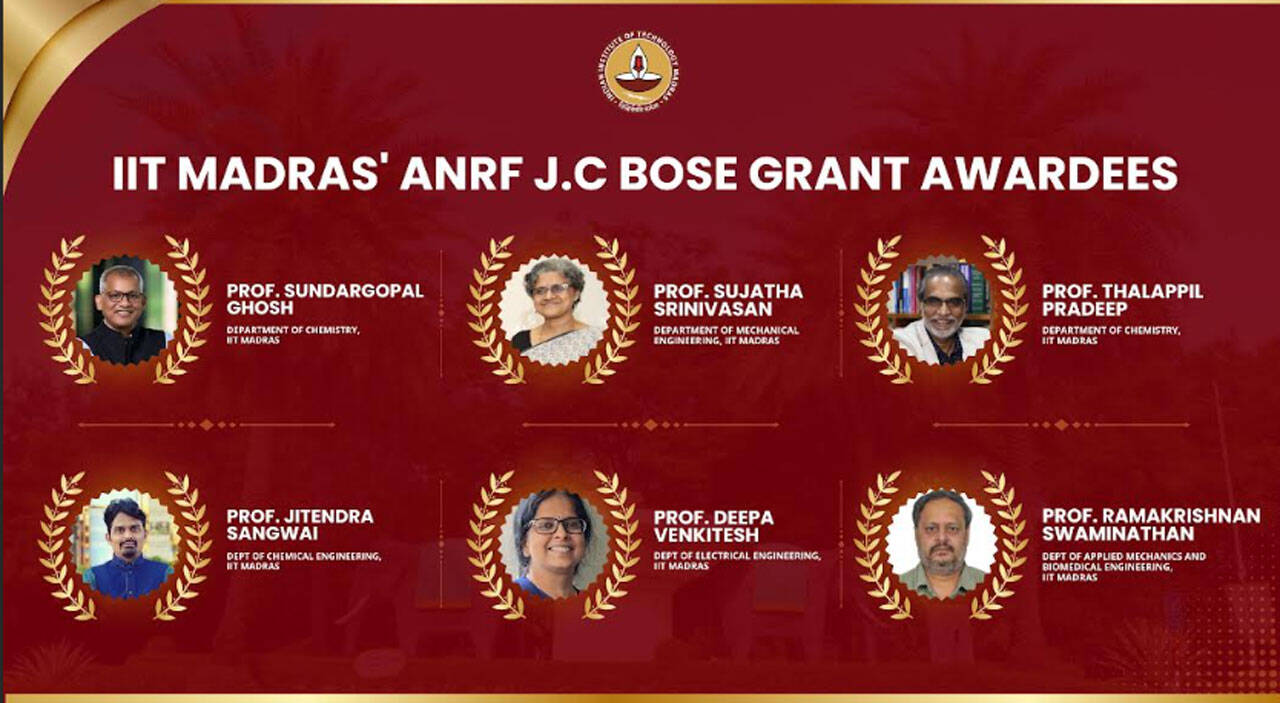
ANRF J. C. Bose Grant awardees from IIT Madras
Why this recognition matters
The selection of six IIT Madras professors for the ANRF J. C. Bose Grant reflects the institute’s strength across multiple disciplines—from healthcare and chemistry to communication technologies, clean energy and sustainability.The grant itself is designed to help accomplished scientists pursue ambitious research that can influence both academia and society. By providing Rs 25 lakh annually for five years, it enables researchers to invest in advanced equipment, research teams and collaborative scientific work that can lead to transformative discoveries.Scientists and engineers between the ages of 45 and 65 are selected through a highly competitive process that evaluates publications, patents, technology transfer, research outcomes, grants and other measures of scientific excellence.Reiterating the significance of the achievement, Prof. V. Kamakoti said: “I congratulate all my distinguished colleagues. This demonstrates the high quality of research and development in critical and emerging technologies happening at IIT Madras.”For students considering careers in science and engineering, the journeys of these six professors offer an important lesson. Breakthroughs in research are rarely built overnight—they emerge from years of curiosity, rigorous experimentation and an unwavering commitment to solving real-world problems.From helping millions gain access to clean drinking water and designing affordable prosthetic devices to advancing communication networks, cleaner energy and medical technologies, these researchers exemplify how science can create lasting impact. Their achievements also remind young learners that a career in research is not only about discovering new knowledge—it is about using that knowledge to improve lives.