

Lenders have been allowed to impose gradual restrictions on the devices after 30 days of the payment being overdue.
Purchased a smartphone, laptop or tablet via loan financing? What happens if you miss an EMI? Can the lender lock your phone or block access to the device? According to a study by Home Credit Finance, the single biggest reason for borrowing in 2025 remained the purchase of smartphones and home appliances.The Reserve Bank of India (RBI) has laid out some guidelines for lenders on recovery of loans, and whether they can block or lock the device that has been purchased via EMI financing. This new framework will come into effect from January 1, 2027.The new framework governing loan recovery practices comes on the back of increasing complaints from borrowers who have alleged harassment in the recovery process. This harassment has in the past taken the form of intimidation through social media and also the use of abusive language.In 2024, RBI asked lenders to stop the practice of locking phones of borrowers in case of default. Lenders were doing this using an app that was installed at the time of the loan issuance.In May this year, the RBI had released a draft framework that outlined proposed norms on the “Conduct of Regulated Entities in Recovery of Loans and Engagement of Recovery Agents”. The central bank had invited comments from stakeholders. The final norms have now been released.What do the new rules mean for you? What are your rights as a borrower and what does a loan default for EMI-financed devices mean for you? We break it down:
RBI’s new rules: Can your phone be locked?
RBI has clearly told lenders that they cannot disable the borrower’s mobile phone, laptop or tablet in cases of loans taken for home, car or other personal loans. The restrictions to use can only come in place for devices that have been financed via loans.“A bank shall not deploy any technology-based mechanism…which restricts or disables any of the functionalities of a mobile device of a borrower such as mobile phone, tablet and laptop as a recovery tool, except to recover its loan dues arising out from financing of such a device,” RBI has said.
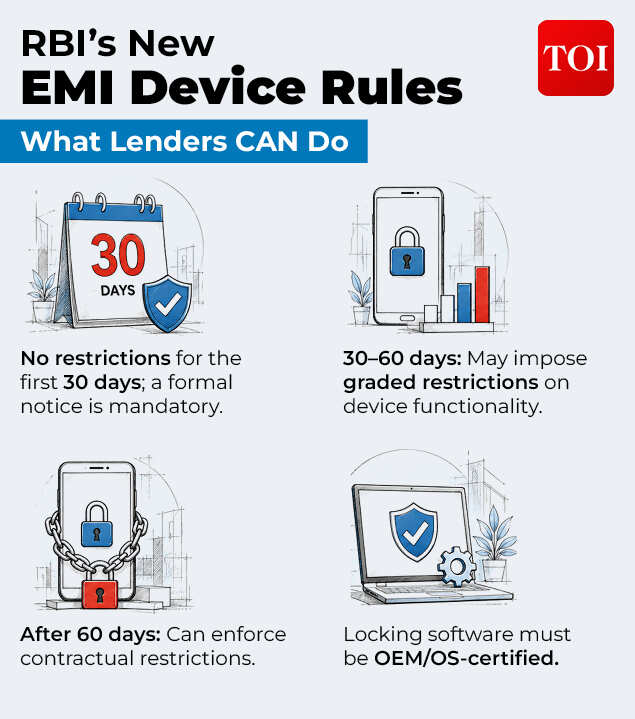
RBI’s New EMI Device Rules: What Lenders Can Do
Even in such cases the restrictions have to be gradual and with certain rules in place. Let’s take a look at what the lender can and can’t do:What the lender can do:Lenders have been allowed to impose gradual restrictions on the devices after 30 days of the payment being overdue.So, to begin with if your EMI is overdue for less than 30 days then the lender cannot do anything to the device. The lender is required to send you a formal notice.If the loan remains overdue between 30-60 days, then the gradual restrictions can be introduced.The full contractual restrictions can only be imposed after the loan has been overdue for more than 60 days.If a device locking software is eventually used, it can only be one that is certified by the original equipment manufacturer or the operating system provider.
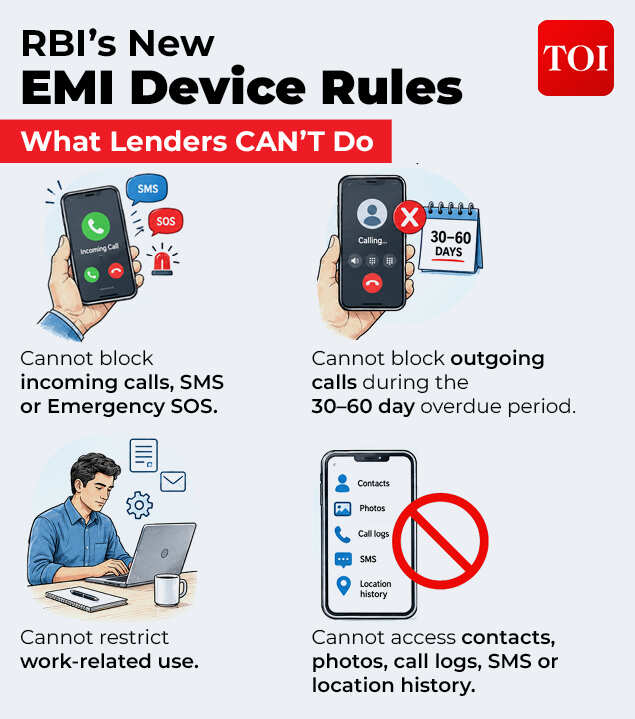
RBI’s New EMI Device Rules: What Lenders Can’t Do
What the lender can’t do:But outgoing and incoming calls cannot be stopped.SMS, Emergency SOS and any restrictions that impact work or employment are not allowed.Lenders cannot access details on the borrower’s phone such as contacts, photos, call logs, location history or even SMSes.Borrowers should also be aware that once the loan payment is received by the lender, the device has to be unlocked within an hour. Any delay in unlocking at the lender’s end will entail a Rs 250 per hour compensation for the borrower, up to the loan amount.Additionally, no uncertified recovery agents will be allowed to interact with the borrowers for the loan.
What do the new rules mean for you?
The biggest takeaway for loan borrowers is that your device can’t be blocked for non-payment of EMIs. Also, if at all any restrictions come into place, they can only be if the loan has financed that particular device. The loan agreement needs to clearly state these conditions.“A missed EMI can no longer make your phone go dark. From 1 January 2027, the default is that lenders cannot lock or disable a device to recover dues at all. The sole exception is a device bought on that specific loan, and only if the agreement says so, notice is given, and functionality is curbed gradually. A defaulted car loan, personal loan or credit card can never touch your phone,” explains Vivek Iyer, Partner and Financial Services Risk Advisory Leader, Grant Thornton Bharat.
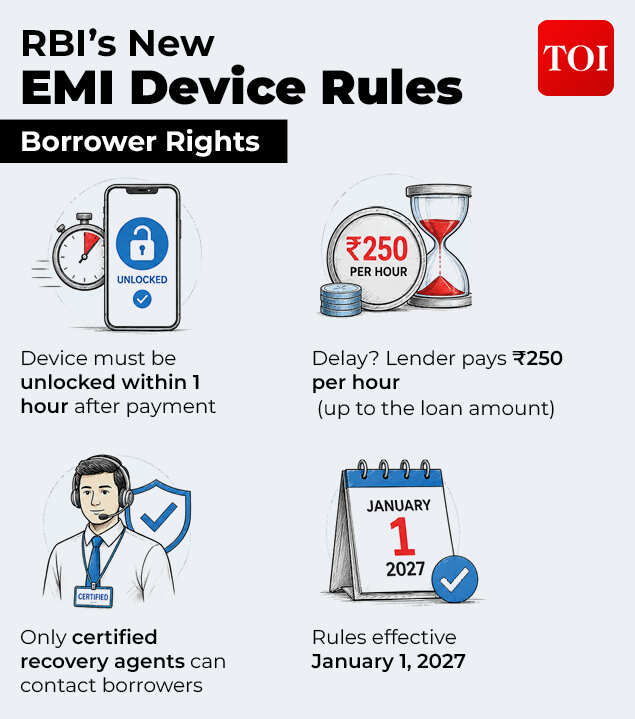
RBI’s New EMI Device Rules: Know Borrower Rights
So the next important thing to note is this: always read the terms and conditions of the loan agreement when opting for an EMI-financed device.“Read the agreement for how it treats remote access and default remedies. The restriction is unenforceable unless written in expressly. Borrow only from regulated lenders, since every safeguard depends on it,” Vivek Iyer recommends.“Set up auto-debit, because 30 days now starts a formal pathway. And insist on written notice. That is your evidence for both the graded-step rule and any compensation claim,” Iyer adds.According to Adhil Shetty, CEO of Bankbazaar.com, the new framework brings greater clarity to how lenders can use technology for recovery of dues on EMI-financed purchases.“It allows action against genuine defaults while placing clearer limits on how that action can be taken. A key safeguard is that a lender cannot restrict a device that was not financed through the loan. For borrowers, the broader impact is greater clarity around their rights and privacy. This should create a better balance between a lender’s need to recover dues and a borrower’s right to fair treatment,” he tells TOI.The Bankbazaar CEO also advocates carefully reading the term agreements instead of just focusing on the monthly EMI figure.“Consumers should look beyond the monthly EMI and understand the financing terms before committing to a purchase. They should check whether the agreement allows device-based recovery and understand the consequences of missing payments,” he tells TOI.Yet another important point to note is that while the RBI’s rules safeguard the privacy and rights of individuals, they do not remove the repayment obligation.“The EMI should therefore be comfortably affordable and the recovery terms understood before taking the loan,” Shetty says.Some steps also need attention after you have repaid the loan.Santosh Agarwal, CEO of Paisabazaar suggests that on successful repayment of the loan, borrowers should get the access relinquished and disable any technology mechanism at the earliest.“It is important for borrowers to retain all repayment proof and contact the lender for unlocking their devices,” she tells TOI.