

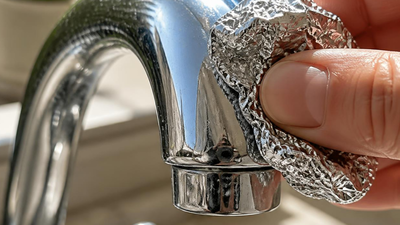
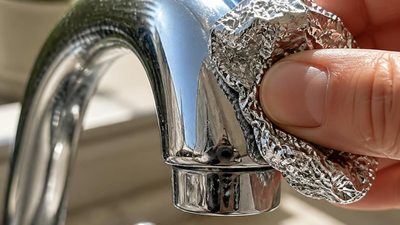
Most of us keep a roll of aluminum foil in the kitchen drawer for covering leftovers, packing lunchboxes, or lining a baking tray, and we hardly think of it as a cleaning tool. Yet this roll, silently doing its job on the kitchen shelf, has found some interesting applications to it and has become one of the most talked-about materials for home hacks recently.Limescale or stains on taps and faucets are a real household issue, and we rarely get around to cleaning the untidy appearance. But what if all the stains on bathware could be cleaned by using just a piece of aluminium foil?Sounds interesting, right?Let’s dig in to find out how this exactly works.
What is the science behind the hack?
So, why this trick is effective all comes back to science. When foil rubs against chrome or stainless steel, the friction generates a small amount of heat that triggers a reaction forming aluminum oxide, a compound that helps clean the stains while polishing the surface. Because foil is soft compared to steel wool or scouring pads, it works as a mild abrasive rather than a harsh one, making it gentler on bathware than many chemical cleaners. Like any other home remedy, though, results vary depending on the faucet’s finish and how much buildup has accumulated.
What is the aluminum foil trick actually used for?
The aluminium cleaning trick helps clean the hard water spots, limescale, and light tarnish that accumulate on faucets over time. Rubbing foil against the metal creates gentle friction that dislodges these mineral deposits without scratching the surface. As the foil rubs against the metal, a small amount of heat forms aluminum oxide, which buffs out water marks and can even reduce minor rust spots on chrome and stainless steel fixtures. It works like a low-cost polish that skips harsh chemical sprays altogether.
Why is it better to use aluminium foil over harsh chemicals?
Many household cleaners for cleaning limescale are composed of strong acids or bleach, which can gradually corrode a faucet’s protective coating and lead to corrosion over repeated use. Aluminum foil, on the contrary, when dampened and rubbed against a metal tap, behaves like a very fine, mild abrasive that breaks down the dirt safely, without needing harsh chemical cleaners. It gives just enough texture to clean the dirt while sparing the finish underneath.
Step-by-step: how to use it correctly
The process is quick and needs no special tools. For cleaning the faucets, tear off a small sheet of foil and crumple it loosely into a ball, keeping some texture rather than pressing it flat, since the ridges provide better scrubbing. Dampen it with water, or dip it in a little vinegar for extra cleaning power against tougher limescale. Rub gently in circular motions over the stained areas, rinse the faucet thoroughly with clean water, and dry it with a microfiber cloth to avoid leaving new water spots behind.
Which faucets work best with this method
Results depend on the type of tap used. Polished chrome and stainless steel faucets tend to respond best, since their smooth, hard surfaces can handle the mild abrasion without leaving marks behind. However, brushed, matte, or specialty-coated finishes should be handled with caution, as these surfaces scratch more easily and should be tested on a hidden spot first, or avoid using foil altogether.
Precautions to keep in mind while cleaning
Even though foil is gentler than most abrasive pads, care is still needed. Always test a small, hidden area first, especially on brushed or matte finishes, since scratches can appear quickly on delicate coatings. Wearing gloves should also be kept in mind during any cleaning task, including this one. If the foil ball starts to darken, flatten, or lose its texture, swap it for a fresh piece rather than continuing to scrub with a worn one.