
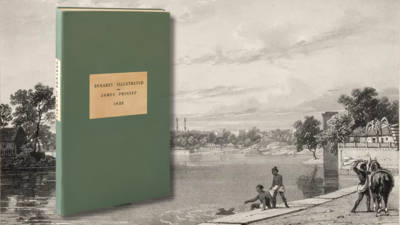
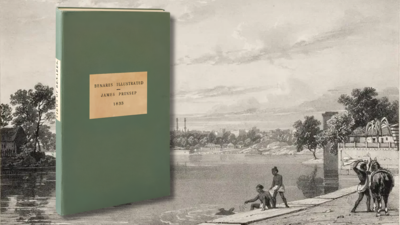
In 1833, British scholar and artist James Prinsep published ‘Benares Illustrated,’ a book documenting Varanasi’s ghats, temples, mosques, palaces and everyday life through 34 illustrations. Nearly 193 years later, a signed copy of the rare volume sold at AstaGuru for Rs 36.76 lakh, more than three times its high estimate of Rs 10 lakh. According to AstaGuru’s auction results, the book fetched Rs 36,75,978, including the buyer’s premium, during its ‘Imperial Treasures’ auction held from February 24 to 26, 2026. The lot had been estimated at Rs 8 lakh to Rs 10 lakh.Printed at the Baptist Mission Press in Calcutta, the 68-page book is a visual record of the city in the early 19th century. Its illustrations cover religious landmarks and riverfront architecture, alongside scenes of people performing rituals and going about their daily activities.
How James Prinsep documented Varanasi
Prinsep (1799–1840) was an artist, architect, numismatist and epigraphist who spent part of his career in India. He arrived in Benares, the city now known as Varanasi, in 1820, where he worked as an assay master and became closely involved in studying the city and its architecture. According to Cultural Heritage of Varanasi, Prinsep’s work combined detailed architectural observation with depictions of religious practices and the people who inhabited the city.He made many of the drawings between 1820 and 1825. The illustrations were subsequently reproduced as lithographs and engravings and published in installments between 1831 and 1833. The completed volume brought together the images with descriptive text. According to The Journal of the Asiatic Society, the plates appeared in three installments. The sequence of illustrations in the original instalments and the completed volume differed slightly.Prinsep explained the purpose of his work in the book’s preface, writing that his drawings made no claim to rival professional views of European cities. Instead, he said, “The only merit aimed at, has been that of faithful delineation.”
Ghats, temples and scenes of everyday life
The illustrations in ‘Benares Illustrated’ show Varanasi as a city shaped by the Ganga and its religious institutions. Prinsep recorded the steps leading down to the river, temple structures, mosques, pavilions and buildings along the waterfront. Among the subjects discussed are Manikarnika Ghat, the Temple of Vishveshwur and a preacher explaining religious texts at the Annapurna Temple. Another illustration depicts a Brahmin placing a garland at a sacred spot.These images combine architectural detail with human activity. The ghats are not shown simply as structures beside the river: people appear on the steps, around temples and in spaces used for worship and other daily activities.The book also records the city’s built environment at a particular point in its history. Prinsep’s illustrations show structures and architectural relationships that can be studied alongside other historical records to understand how Varanasi looked during the early 19th century.However, the images should also be read in the context of the period in which they were produced. Prinsep was a British colonial-era observer, and his descriptions reflected the interests and assumptions of his time. His work is valuable as a historical record, but it is not a neutral account of every aspect of the city.
Why the signed edition matters
According to AstaGuru, the auctioned volume was signed by Prinsep and contained 34 plates across 68 pages. It measured approximately 18.5 by 13.5 inches (47 by 34.3 cm). The auction house described the work as one of the earliest important pictorial surveys of an Indian city. Its combination of illustrations and written descriptions gives it value as both an art-historical object and a record of Varanasi’s architecture and urban life.The book also reflects the collaborative process behind 19th-century illustrated publications. AstaGuru notes that the drawings were translated into lithographs and engravings by artists of the period, including Louis Haghe. The signed copy sold in February 2026 was described by AstaGuru as well-used, with age-related wear. Despite its condition, it achieved Rs 36.76 lakh against an estimate of Rs 8 lakh to Rs 10 lakh.