
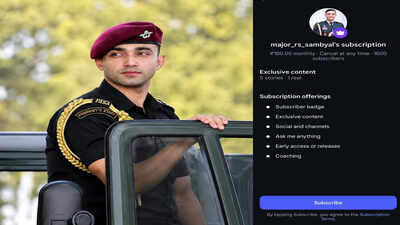
Major Rishabh Singh Sambyal spent years in uniform. He led the Jat Regiment contingent at the Republic Day Parade, served with 4 Para Special Forces and later became Aide-de-Camp to President Droupadi Murmu.Now, after leaving the Indian Army, he has entered a very different space: paid social media content.And that has sparked a debate.Sambyal’s Instagram subscription, reportedly priced at ₹199 a month, has drawn criticism from some social media users who feel a former Army officer should not monetise the following he built during his military career. Others see nothing unusual about it, arguing that retirement gives him the freedom to choose another profession and earn from his public profile.The debate gained traction after an X user criticised the subscription and called it “a shame and a downgrade for the Army”. Sambyal responded simply: “Some see a downgrade. A soldier sees another way to serve.”So what exactly is the controversy about?
What does Sambyal’s Instagram subscription offer?
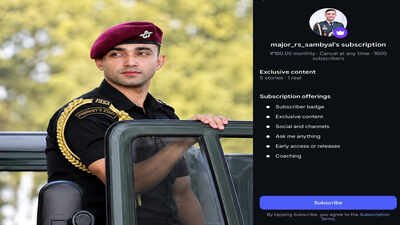
Instagram’s subscription feature allows creators to charge followers for access to additional content and interactions.In Sambyal’s case, reports say subscribers get access to exclusive content, subscriber badges, early access to posts and reels, and opportunities to interact with him through “ask-me-anything” sessions.The criticism isn’t really about how Instagram’s subscription system works. It is about whether Sambyal’s military background makes monetising his online following different from what another creator might do.Some users argue that much of his popularity came from his time in the Army, particularly his appearances alongside President Murmu. That has led to questions over whether it is appropriate to turn that public recognition into a paid platform.Others don’t see the connection in the same way.Their argument is straightforward: Sambyal is retired. His Army career is over, and he is entitled to decide what he does next.
Why did Major Rishabh Singh Sambyal become famous?
Sambyal first attracted wider public attention in 2021, when he was a Captain in the Jat Regiment and led its contingent during the Republic Day Parade. The contingent went on to win the Best Marching Contingent Trophy.He later volunteered for 4 Para Special Forces and earned the Balidaan Badge, before being selected as an Aide-de-Camp to President Droupadi Murmu in March 2023.The ADC assignment put him regularly in the public eye. Photographs and videos of him accompanying the President at official events were widely shared online, and he gradually became a familiar face beyond military circles.By 2026, social media had given him a level of public recognition that is unusual for an Army officer whose role is otherwise centred on duty and protocol.
Why did he leave the Army?
Sambyal took premature retirement in 2026 after around 12 years in the Indian Army. Recent reports say he described the decision as one of the hardest of his life and cited family commitments as a major factor.After leaving the service, he met President Murmu at Rashtrapati Bhavan on August 21. In a social media post, he thanked her for her guidance and blessings and described the meeting as a chance to reconnect with the President and her family.That context matters when looking at the current controversy. The subscription was launched after his military career had ended.
Why are some people calling it a ‘downgrade’?
The criticism comes largely from the idea that an Army officer, particularly one who held a high-profile position as the President’s ADC, should maintain a certain image even after retirement.For those users, the issue isn’t simply that Sambyal is earning money online. It is that his social media popularity is closely linked to his years in uniform.That view, however, is an opinion rather than an established rule.There is also a practical question: where does a retired officer’s professional identity end and his personal career begin?Retired service personnel have moved into many fields over the years, including business, education, corporate work, consulting and public-facing careers. Social media is another possible route.
What are his supporters saying?
Supporters argue that leaving the Army does not mean giving up the right to earn a living or build a second career.They also point out that subscribing is voluntary. People who don’t want exclusive content can continue following Sambyal’s public posts without paying.From this perspective, the ₹199 subscription is a product that followers can choose to buy. Whether it is worth paying for is ultimately a question for individual subscribers.There is also a distinction between questioning the price or value of a subscription and questioning a person’s military service because they chose to monetise their popularity afterwards.
Is there anything wrong with a retired officer becoming a content creator?
That depends on what the former officer is actually doing.A retired military officer remains subject to applicable laws, service-related obligations and restrictions. Concerns would be different if someone were disclosing classified or sensitive information, falsely presenting themselves as a serving officer or using confidential military material for commercial purposes.But the controversy around Sambyal’s subscription, based on the reporting available so far, centres on the decision to offer paid Instagram content after retirement.That makes the debate less about whether a soldier is allowed to earn and more about how people view the transition from military service to public life.
The larger debate behind the ₹199 subscription
Perhaps that’s why the reaction has been so divided.For some, Sambyal’s Army identity is inseparable from the public image that made him popular. For others, his service and his post-retirement career are two separate things.Both sides are responding to the same fact: a former Army officer who became widely known while serving the President is now trying to build a new career around his online audience.And social media has made that transition visible to everyone.Sambyal’s military record includes his Republic Day Parade role, service with 4 Para Special Forces and his tenure as President Murmu’s ADC. Those are documented parts of his Army career.His Instagram subscription is something else entirely.People can question its price, decide whether the content is worth paying for, or dislike the idea of a former officer monetising his following. But those are questions about his new career, not a substitute for assessing what he did during his years in uniform.