
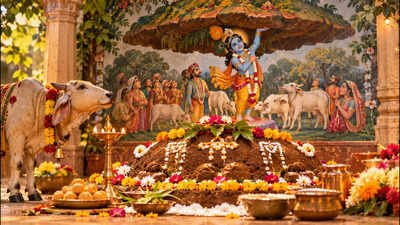
The day after Lakshmi Puja is usually set aside for Govardhan Puja. That is why many households expected it on Monday, 9 November this year. But the Panchang tells a different story. In India, Govardhan Puja 2026 falls on Tuesday, 10 November 2026.
Why the Festival Moves to 10 November
Govardhan Puja is performed on Kartik Shukla Pratipada, the first lunar day after the new Moon of Diwali. This year the Amavasya tithi runs past sunrise on 9 November and only ends at 12:31 PM. Pratipada begins at that moment and continues until 2:00 PM on 10 November.So on the morning of 9 November, the day still belongs to Amavasya. The morning puja, which is the main ritual of Govardhan, cannot be done on a tithi that has not yet begun. On 10 November, Pratipada is present at sunrise and through the morning hours. That makes Tuesday the correct day under the udaya tithi rule.Devotees settled in North America will see a different date on their local calendar. With the clock running several hours behind India, the deciding sunrise in the USA falls on Monday, 9 November. Temples there will mark the festival a day earlier, and that local date is the one to follow.
Govardhan Puja 2026 Shubh Muhurat
·Date: Tuesday, 10 November 2026·Pratipada tithi begins: 12:31 PM, 9 November 2026·Pratipada tithi ends: 2:00 PM, 10 November 2026·Pratahkala puja muhurat (Delhi): 6:40 AM to 8:50 AMThe morning window shifts a little with local sunrise, so cities in the west of the country will start a few minutes later. Since Pratipada closes at 2:00 PM, the Annakut offering and all main rituals should be finished well before the early afternoon.The same Pratipada also marks Bali Pratipada in western and southern India and the start of the new year in the Gujarati calendar. Many trading families open fresh account books on this morning.
The Story of Govardhan
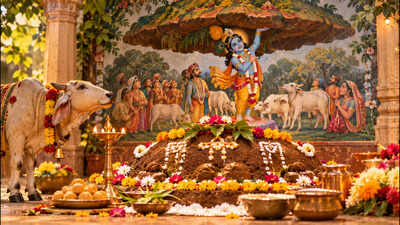
The festival recalls an episode from Lord Krishna’s childhood in Vraj. The people of the village used to hold a large annual offering to Indra, the god of rain. Young Krishna asked them to worship Govardhan hill instead, since it gave their cattle grass and their homes water and shelter.Indra took offence and sent torrential rain for seven days. To protect the villagers and their animals, Krishna lifted the entire hill on the little finger of his left hand and held it up like an umbrella. Everyone gathered beneath it until the storm passed. Indra finally accepted his error. Since then, the hill itself has been honoured as a form of Krishna, and the day teaches respect for nature and the land that feeds people.
How to Perform Govardhan Puja at Home
Wake early, bathe and clean the courtyard or the area near the main door. Traditionally, a small figure of Govardhan is shaped from cow dung in the form of a reclining man, with a navel marked in the centre. Where cow dung is unavailable, families use clay or simply place a picture of Krishna holding the hill.Decorate the figure with flowers, grass and small lamps. Offer water, roli, rice, sweets and a little milk or curd at the navel. Then walk around the Govardhan figure seven times while chanting Krishna’s name, carrying a lamp or a pot of water.The heart of the day is Annakut, which means a mountain of food. Prepare as many vegetarian dishes as possible and arrange them before the deity. Large temples present 56 items, known as chhappan bhog, but a home offering of even a few simple dishes made with devotion is fully valid. After the aarti, share the prasad with family, neighbours and anyone in need.Cows hold special honour on this day. Bathing them, applying tilak and feeding them green fodder or jaggery is considered highly meritorious.
Things to Remember
Do not perform the puja on 9 November in India, since Amavasya prevails that morning. Avoid non-vegetarian food and alcohol through the day. And keep the offerings simple and clean. Krishna values sincerity over display, which is the very lesson of the Govardhan story.Many families also observe Dyuta Krida, a light game of dice played on this Pratipada in memory of Shiva and Parvati. It is meant purely as a festive custom and never as gambling for money.