


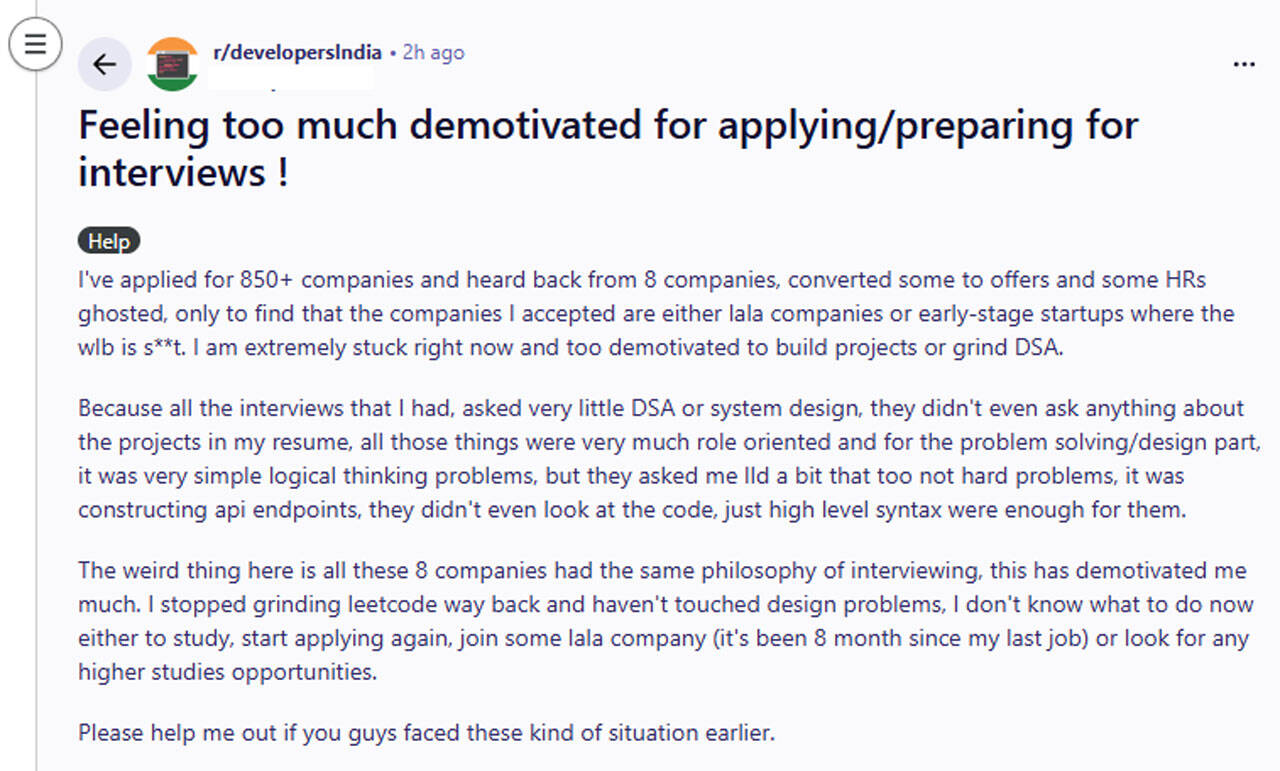
“I’ve applied to 850+ companies… and I’m too demotivated to prepare for interviews anymore.”That one sentence, shared anonymously on Reddit, has resonated with thousands of software engineers and fresh graduates navigating one of the toughest hiring markets in recent years.The post wasn’t just about rejection. It reflected something many young professionals are quietly struggling with—burnout from job hunting itself. Hundreds of applications, months of uncertainty, interviews that don’t follow any predictable pattern, and the constant fear of falling behind have left many wondering whether they’re preparing for the right skills at all.
Software engineer’s 850 job applications spark debate on today’s hiring market
Eight months, hundreds of applications and just eight interview calls
The software engineer, who has around one year of internship experience and six months of full-time experience in backend development, shared that he had applied to more than 850 companies.Out of those, only eight companies responded.Some interviews resulted in offers, while others ended without any communication from recruiters. The offers he eventually received, he claimed, were from organisations where work-life balance did not match his expectations.The experience left him questioning everything.He admitted that he had gradually stopped practising data structures and algorithms (DSA) because most interviewers hardly focused on them.Instead, the interviews revolved around practical, role-specific discussions.“They didn’t even ask anything about the projects in my resume,” he wrote, adding that interviewers were more interested in basic logical thinking, backend concepts and simple low-level design discussions than competitive programming questions.For someone who had spent months preparing for conventional technical interviews, the experience was confusing.
“The hiring playbook seems broken”
The post quickly attracted hundreds of comments from engineers, recruiters and job seekers who said they were facing similar struggles.One experienced software engineer observed that the industry currently faces a strange paradox.“On one side, companies are not getting good candidates to fill their positions. On the other hand, candidates are not getting callbacks or job offers because the skills do not match what the company is expecting. We are in a very weird situation.”Several users argued that there is no single formula for cracking interviews anymore.Some companies emphasise DSA and system design. Others focus almost entirely on practical knowledge related to the role. Start-ups may prioritise problem-solving ability, while larger organisations often evaluate communication, ownership and teamwork alongside technical expertise.Many commenters felt this unpredictability itself has become one of the biggest challenges for applicants.
“Don’t let eight interviews define the market”
Perhaps the most encouraging responses came from professionals who had gone through similar phases.One engineer, who had recently been laid off, admitted that repeated rejections after multiple interview rounds had been emotionally exhausting.Another user summed up the uncertainty of today’s hiring landscape with a simple message:“Keep going. It all changes on a random Tuesday evening.”Others reminded the original poster that eight interviews do not represent the entire job market.One commenter advised him to accept the best available opportunity, continue applying elsewhere and keep interview preparation going without putting excessive pressure on himself.Several community members also shared lists of remote-job platforms and international hiring websites, encouraging him to widen his search instead of relying only on conventional job portals.
What students and fresh graduates can learn
For engineering students and recent graduates, the discussion offers an important reality check.Preparing for coding interviews is still valuable, but recruiters increasingly look for much more than LeetCode scores. Practical skills, internships, communication, backend concepts, cloud technologies, debugging ability and understanding real-world software systems are becoming equally important across many organisations.Another lesson is psychological.Job searching today is no longer a numbers game where every application guarantees a response. Rejections often reflect market conditions, hiring freezes or changing business priorities rather than a candidate’s capabilities.Career experts frequently advise graduates to keep learning, continue building projects, seek feedback after interviews whenever possible and remain flexible about their first role.The first job may not always be the dream job—but it can become the stepping stone to one.The anonymous Reddit post may have begun as a cry for help, but the responses it received carried a powerful reminder for thousands of young professionals reading it: in today’s job market, resilience may be just as important as technical skills.Disclaimer: This article is based on a publicly available discussion on Reddit. The experiences shared are personal opinions of individual users and may not represent the hiring practices of all companies or the broader technology industry.