
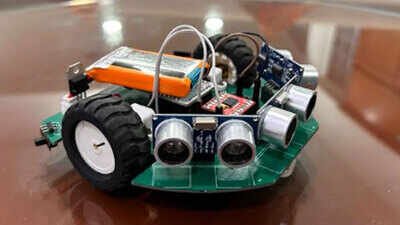
A team of school students from Jaipur has developed an autonomous maze-solving robot that can navigate unfamiliar environments, detect obstacles and identify efficient routes without human intervention. The innovation has received a patent and earned the students a cash prize of Rs 1 lakh from the Government of India.The robot uses a combination of ultrasonic sensors, encoder feedback and gyroscopic sensing to detect its surroundings, maintain directional accuracy and make navigation decisions. Its mapping system enables it to explore an unfamiliar maze, identify possible routes and determine a path towards its destination.The project was developed by students of Dharav High School in Jaipur, who integrated robotics, electronics and programming to build the autonomous system. The robot also uses a VSD Squadron FPGA Mini processing unit to handle real-time sensor inputs, motor control and navigation decisions.How the maze-solving robot worksUnlike conventional robots that primarily depend on basic wall-following mechanisms, the student-developed system combines multiple sensing technologies to improve navigation accuracy.Its ultrasonic sensors detect walls and measure distances, helping the robot identify obstacles in its path. Encoder feedback monitors wheel movement to support precise distance and movement control, while gyroscopic sensing helps maintain orientation and stability during turns.The robot’s mapping system gradually builds an understanding of the maze as it moves through the environment. Using the information collected by its sensors, it identifies possible routes and determines an efficient path towards the destination.The integration of these technologies is intended to reduce navigation errors, improve turning accuracy and ensure consistent movement in unfamiliar maze layouts.Principal highlights role of practical learningSpeaking about the achievement, Ms Nishi Dhanjal, principal of the school, said that the project reflected the importance of encouraging scientific thinking, experimentation and practical learning among students from an early age.She said the students had transformed their curiosity and technical knowledge into an innovation, adding that the Government of India recognition and patent made the achievement particularly significant.Dhanjal also highlighted the role of opportunities to explore emerging technologies in helping students develop creativity, problem-solving abilities and confidence.Robotics and experiential learning in schoolsThe project brings together concepts from several areas of science and technology, including robotics, electronics, programming and engineering. Its development also illustrates how students can apply classroom concepts to build working technological systems.Hands-on projects involving autonomous robots expose students to practical aspects of engineering, including sensor integration, movement control, data processing and programming logic.The students’ achievement comes amid growing emphasis on STEM education and experiential learning in schools, where project-based activities provide opportunities to apply theoretical knowledge to practical challenges.The patented innovation and government recognition mark an achievement for the student developers, who have demonstrated the application of robotics and intelligent navigation technologies through a school-level project.