
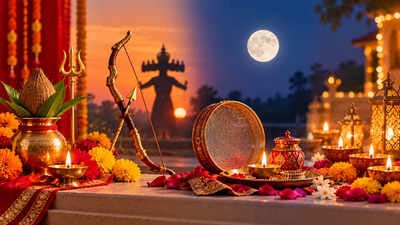
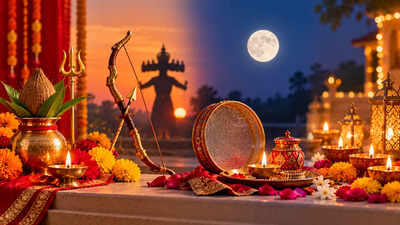
Ask an Indian friend what’s happening this month, and you might get a long answer. Navratri. Then Dussehra. Then a short breather before Diwali. Somewhere in there, a full moon festival, a fast for husbands and a mountain of sweets.It can sound like a blur of holidays. But these festivals aren’t random. They are linked, one after the other, almost as chapters of the same story. Once you see how they connect, the whole season makes a lot more sense.
It Starts With the Ancestors
Before any of the celebrating begins, there’s a quiet fortnight called Pitru Paksha. Families spend these days honouring relatives who have died, offering water, sesame seeds and food in their names.This year it ended on October 10. And the very next morning, the mood flips.
Navratri: Nine Nights for the Goddess
Navratri runs from October 11 to October 19 in 2026. The name literally means “nine nights.”Each night honours a different form of the goddess Durga. The best-known story behind it involves Mahishasura, a buffalo demon who couldn’t be beaten by any god. Durga fought him for nine days. On the tenth, she won.How people celebrate depends a lot on where they’re from. In Gujarat, it’s Garba, with thousands dancing in circles until well past midnight. South Indian families set up Golu, tiered displays of small dolls and figurines, and invite neighbours over to see them. Many North Indian households fast for the full nine days, eating only fruit, milk and special flours.And in Bengal, the last five days turn into Durga Puja. Giant, hand-sculpted idols of the goddess go up in elaborate pandals, temporary structures that can be as big as a building. Kolkata becomes one enormous street festival.
Dussehra: Good Wins, Twice Over
Day ten is Dussehra, also called Vijayadashami. This year it falls on Tuesday, October 20.Here’s where it gets interesting. Two different victories are celebrated on the same day.One is Durga’s win over Mahishasura, which closes out Navratri. The other comes from the Ramayana, the great Indian epic. Lord Rama defeats Ravana, the ten-headed demon king who kidnapped his wife Sita.Across North India, towering effigies of Ravana, sometimes over 50 feet tall, are stuffed with fireworks and set on fire after sunset. Crowds cheer as they burn. Kids love it. It’s loud, smoky and completely unforgettable the first time you see it.Some regions have their own famous versions. Mysuru in Karnataka puts on a royal procession with decorated elephants. In the Himalayan valley of Kullu, Dussehra actually begins on the day it ends elsewhere and runs for a full week.
The Gap Before Diwali
After Dussehra, there’s a stretch of about three weeks. So what’s going on?Tradition offers a lovely answer. After defeating Ravana in Lanka, Rama needed time to travel home to his kingdom of Ayodhya. The weeks between Dussehra and Diwali are often linked with that trip back.The calendar doesn’t sit still, though. Sharad Purnima, the harvest full moon, falls in late October. Many families leave rice pudding out under the moonlight overnight, believing it absorbs healing energy. Then comes Karwa Chauth, when married women in North India fast from sunrise until they see the moon, praying for their husbands’ long lives.Meanwhile, households start cleaning. And not a quick tidy-up. Full-on, move-the-sofa, wash-the-curtains cleaning, because Diwali is coming.
Diwali: Lights for a Homecoming
Diwali falls on Sunday, November 8, in 2026. It’s actually a five-day festival.Dhanteras kicks things off on November 6. People buy gold, silver or even a new steel pot for the kitchen, believing it brings wealth for the year ahead. Choti Diwali follows on the 7th, and that’s usually when the firecrackers start in earnest.By the evening of the 8th, almost every balcony in an Indian neighbourhood has a row of tiny clay lamps flickering along its edge. These are diyas, filled with oil or ghee and lit by hand, one at a time. Someone in the house has probably spent the afternoon kneeling at the front door, making a rangoli design out of colored powder. Fairy lights get draped over railings, plants, and sometimes the family car.Why all the light? In the Ramayana tradition, the people of Ayodhya lit lamps to guide Rama home after fourteen years in exile. Later that night, families gather for Lakshmi Puja, praying to the goddess of wealth to visit their home and stay for the year.Govardhan Puja and Bhai Dooj round things off on November 9 and 10. Bhai Dooj is a sweet one. Sisters pray for their brothers’ well-being, and brothers bring gifts in return.
And It Still Isn’t Over
Just when you think the season’s done, Chhath Puja arrives in mid-November, especially in Bihar and eastern Uttar Pradesh. Devotees stand in rivers at sunrise and sunset, offering prayers to the Sun.Then, on November 20, Dev Uthani Ekadashi marks the day Lord Vishnu is believed to wake from a four-month rest. For many Hindu families, that’s the green light for wedding season. The banquet halls start filling up almost immediately.If you’ve ever wondered why your Indian coworkers seem so busy from late September to late November, now you know.