
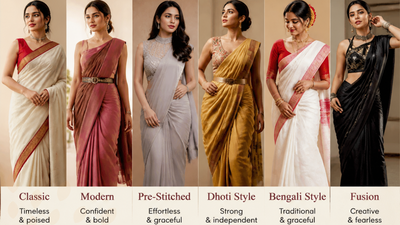
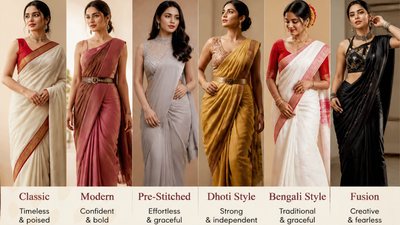
Wearing a saree is not just limited to the feeling of donning an attire; it is the emotion of putting on grace, and the pallu gently glides down the shoulder, and the pleats get tucked.On some mornings, the saree is already waiting on the bed before you are ready for the day. Six yards of cloth, folded patiently, like a question, and you quietly stand and wonder: how should I drape this today?And then you pleat, tuck, drape, and somewhere in those few minutes, something changes, and a little feeling of change crawls in. The walk becomes slower, a little braver and more elegant. The same fabric, folded differently, and suddenly you feel like someone else. Or maybe, more truthfully, like someone you had forgotten.Our grandmothers never called it psychology. They just knew. They knew that a saree is never only a saree. It is memory, mood, and a small, private way of saying, “This is who I am today.”But is it only poetry? Or is there something real in that quiet feeling, something researchers have noticed too?Let’s find out what psychology has to say about the clothes we wear, and the women who wear them in so many different ways.
Why changing your saree drape can feel like changing your mood
A 2022 study in Fashion, Style & Popular Culture interviewed seven women aged 26 to 34. The researchers concluded that personal clothing style can express a woman’s true self, her ideal self and her creative self. In other words, an outfit can show who she is, who she hopes to become, and how imaginative she is. One participant said according to the paper: “it’s not in your closet, it’s in you.”The authors also point to earlier research by Guy and Banim (2000), which found that women use clothing to show different images of themselves in everyday life, both actual and desired. A saree is a very flexible canvas for that.
Clothes can also influence how we think
Researchers Hajo Adam and Adam Galinsky, writing in the Journal of Experimental Social Psychology in 2012, found that wearing a lab coat described as a doctor’s coat increased sustained attention compared with wearing the same coat described as a painter’s coat. They called this “enclothed cognition,” which depends on both what the clothes mean and the physical experience of wearing them.Similarly, a bold blouse pattern with a sleek saree style or a seedha pallu saree drape may quietly influence how you see yourself as confident, relaxed, or festive, and could change how you carry yourself.
Comfort is the clue
In the 2022 study, the women felt comfortable and confident when their clothes matched how they saw themselves. When they didn’t, they felt self-conscious, and a participant said she found it hard to focus on what she was doing. So experimenting with drapes isn’t about putting on a mask. It’s more about finding the version that feels most like you on that day.
Not everyone needs to experiment
The same study found that some women like having a consistent style, almost like a signature. And for many Indian women, a saree carries family history and heritage, and an expression of identity, not just clothing.So, you enjoy trying a Nivi drape one day and a Gujarati one the next; psychology offers a gentle explanation: you may be expressing different sides of yourself